

Neurosurgery Treatment in Thailand at Bumrungrad International Hospital
Bangkok's dedicated Neuroscience Centre with state-of-the-art technology and treatments for brain tumours, cerebral aneurysm, brain injury, spine conditions.


Why International Patients Choose Bumrungrad for Neurosurgery
Bangkok's most integrated neuroscience centre for emergency brain care, complex neurosurgery, and stroke treatment.
What sets Bumrungrad apart for Neurology and Neurosurgery:
- 24/7 emergency neurology direct to neurosurgeons and interventional radiologists.
- 10 dedicated Neurocritical Care rooms for continuous post-surgical monitoring.
- Stroke clot-dissolving therapy aligned with the 4.5-hour treatment window.
- Neurosurgeons, neurologists, rehabilitation specialists, and neurocritical care nurses on every case.
- Written cost estimate provided before departure.
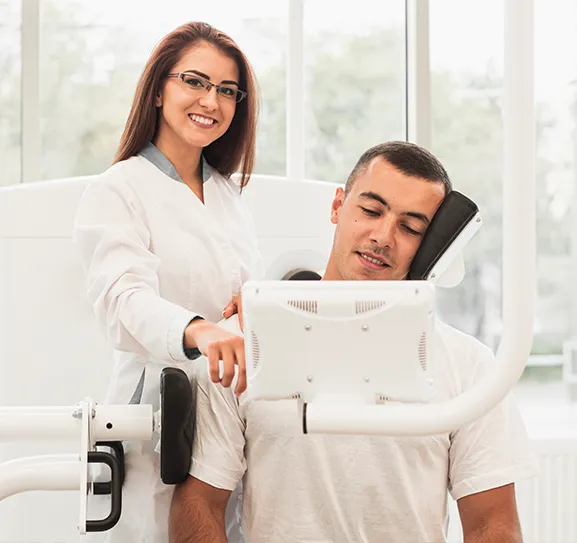
Neurosurgery Technology at Bumrungrad Hospital, Bangkok
- MRI brain and spine imaging
- CT scan brain imaging
- EEG electroencephalography
- TCD transcranial Doppler ultrasound
- TMS transcranial magnetic stimulation
- Biplane angiography operating suite for vascular procedures
Neurology and Neurosurgery Treatments at Bumrungrad
Each treatment plan is built around your scan findings, diagnosis, and neurological risk by a multidisciplinary team of neurosurgeons, neurologists, and interventional radiologists working to international standards. Endovascular clot retrieval for ischaemic stroke
Restores blood flow to the brain when time sensitive stroke treatment is needed.
Inquire
Endovascular clot retrieval for ischaemic stroke
Restores blood flow to the brain when time sensitive stroke treatment is needed.
Inquire
 Neurosurgery for brain tumour removal
Targets tumour related symptoms and protects brain function through specialist planning.
Inquire
Neurosurgery for brain tumour removal
Targets tumour related symptoms and protects brain function through specialist planning.
Inquire
 Cerebral aneurysm treatment and neurosurgery
A cerebral aneurysm can rupture and cause subarachnoid haemorrhage or life
Inquire
Cerebral aneurysm treatment and neurosurgery
A cerebral aneurysm can rupture and cause subarachnoid haemorrhage or life
Inquire
 Intracerebral haemorrhage neurosurgery
Targets brain pressure and bleeding control when emergency intervention is needed.
Inquire
Intracerebral haemorrhage neurosurgery
Targets brain pressure and bleeding control when emergency intervention is needed.
Inquire
 Deep brain stimulation DBS surgery for Parkinson’s
Helps reduce movement symptoms when medicines are no longer enough.
Inquire
Deep brain stimulation DBS surgery for Parkinson’s
Helps reduce movement symptoms when medicines are no longer enough.
Inquire
Insurances Accepted
Explore insurances accepted at Bumrungrad International Hospital.jpg) à la carte healthcare (ALC Health)
à la carte healthcare (ALC Health)
 Accident & Health International
 ADAC-Schutzbrief Versicherung
 Aetna Insurance
.jpg) AFSPA (American Foreign Service Protective Association)
AFSPA (American Foreign Service Protective Association)
 AIA - American International Assurance Co., Ltd.
 AIA Shared Services
 AIG Global
 Aioi Bangkok Insurance
 Akeso Care Management, Inc.
 Al Koot Insurance and Reinsurance Company P.J.S.C
 Alliance International Servicing
 Allianz Ayudhya General Insurance
.jpg) Allianz Global Assistance (USA)
Allianz Global Assistance (USA)
 Allianz Insurance
.jpg) April Assistance (Thailand)
April Assistance (Thailand)
.jpg) Asian Assistance (Thailand)
Asian Assistance (Thailand)
.jpg) Asian Travel And Medical Services (ATMS)
Asian Travel And Medical Services (ATMS)
 Assist International Services
.jpg) AWP Services (Thailand)
AWP Services (Thailand)
 AXA Assistance USA
 AXA Insurance
 AXA Insurance Thailand
 Bangkok Insurance
 Bangkok Life Assurance
 Blue Cross Blue Shield
 BlueVenture TPA
 BUPA
BUPA
 CEGA
CEGA
.jpg) Chubb Insurance (Thailand)
Chubb Insurance (Thailand)
 Chubb Samaggi Insurance
 Cigna Insurance
 Claria
 CMN Global Inc
 Daman
Daman
Daman
Daman
 DavidShield International Medical Insurance
![Delaware American Life Insurance Company [Metlife]](https://my1healthstorage.blob.core.windows.net/my1health/insurances/Delaware American Life Insurance Company [Metlife].jpg) Delaware American Life Insurance Company [Metlife]
Delaware American Life Insurance Company [Metlife]
 Dhipaya Insurance
 EMA Global
 Emergency Assistance Japan
.jpg) Euro Center (Thailand)
Euro Center (Thailand)
.jpg) Eurocross International (The Netherland)
Eurocross International (The Netherland)
 Europ Assistance
 Falck Global Assistance
 Falcon insurance
 First Assistance
.jpg) FPG Insurance (Thailand)
FPG Insurance (Thailand)
 FWD Life Insurance
.jpg) Generali Life Assurance (Thailand)
Generali Life Assurance (Thailand)
 GeoBlue
 Global Assistance
.jpg) Global Benefits Group (GBG)
Global Benefits Group (GBG)
 Global Response
 Global Voyager Assistance
.jpg) Globality Health (Service provides by Euro Center)
Globality Health (Service provides by Euro Center)
 GMMI - Global Medical Management
 Healix New Zealand Ltd
 Health 360 Ancillary WLL
 Henner Insurance
 Houghton Street Consulting
 HTH Worldwide
 Inter Mutuelles Assistance G.I.E.
Inter Mutuelles Assistance G.I.E.
Inter Mutuelles Assistance G.I.E.
 International Medical Group
.jpg) International SOS Services (Thailand)
International SOS Services (Thailand)
 Island Home Insurance Company - Staywell Guam Inc
 iTravelInsured
 Krung Thai AXA Life Insurance
 Kyoei Fire and Marine Insurance Company
 LawtonAsia Insurance Brokers
 Liberty Insurance
 LMG Insurance
 Lockton Wattana Insurance Brokers
 Luma
Luma
 Malteser Hilfsdient GmbH
 Med-Sure Services
 MedAir Global Doctor
 Medilink Beijing TPA
 Mitsui Sumitomo Insurance
 Morgan Price International Healthcare
 MSH CHINA Enterprise Service
.jpg) MSIG Insurance (Thailand)
MSIG Insurance (Thailand)
 Muang Thai Life Assurance
Muang Thai Life Assurance
Muang Thai Life Assurance
.jpg) Mutuelle Des Patentes Et Liberaux (MPL)
Mutuelle Des Patentes Et Liberaux (MPL)
 Navakij Insurance
.jpg) NEXtCare (Service provides by Allianz Partners)
NEXtCare (Service provides by Allianz Partners)
 Northcott Global Solutions Limited
 NOW Health
 P.T. Global Asistensi Manajemen Indonesia
 Pacific Prime
 Paramount Healthcare Management
 Phillip Life Assurance
Phillip Life Assurance
Phillip Life Assurance
 Ping An Health Insurance
 Prestige International
.jpg) Prudential Life Assurance (Thailand)
Prudential Life Assurance (Thailand)
Prudential Life Assurance (Thailand)
Prudential Life Assurance (Thailand)
.jpg) QLM Life & Medical Insurance (QLM)
QLM Life & Medical Insurance (QLM)
 Rabbit Life Insurance
 Redbridge Insurance
 SOMPO Holdings
.jpg) Sompo Insurance (Thailand)
Sompo Insurance (Thailand)
.jpg) SOS International (The Netherland)
SOS International (The Netherland)
 SOS International Assistance Ltd
 Southeast Life Insurance
 TakeCare Insurance
 Tangiers International
 Thai Life Insurance
 Thaivivat Insurance
 The Deves Insurance
 Tokio Marine Nichido Fire Insurance
 Tokio Marine Safety Insurance
 Trails of Indochina
 TRICARE
 Tune insurance
 Ulink Assist
 United Health International, Inc
 Viriyah Insurance
 VYV International Assistance
.jpg) WellBe Medic and Insurance Brokers (Thailand)
WellBe Medic and Insurance Brokers (Thailand)
 William Russell Limited
 World Travel Protection
Discover your insurance options at Bumrungrad International Hospital
Looking for a specific insurance provider? Simply use our search function or contact us for assistance and our knowledgeable team will happily verify whether your provider is accepted at our facility.
Ask about your insuranceCare Journey for International Patients
Your treatment journey made simple and stress-free in 5 easy steps
-
1
Online inquiry & medical files upload Share your medical reports for review. It takes less than a minute.
-
2
Doctor review & treatment plan Within 24hrs you will receive treatment options & a preliminary plan before travel.
-
3
Travel coordination We arrange your visa, flights, and accommodation.
-
4
Treatment phase Full care under a dedicated case manager.
-
5
Start your treatment Begin treatment with full support from our care team.
Our Patients' Heartfelt Stories
See what they have to say

Related Articles

Feeling lost navigating neurological care? Discover why Bumrungrad Hospital in Bangkok could be your path to recovery.
Read more
When it comes to medical tourism, Thailand's reputation soars. Find out why.
Read more
Every second counts when a stroke strikes—Bumrungrad offers world-class treatments to save lives & maximise recovery.
Read moreFrequently Asked Questions
Have a question? Our support team is here to guide you through each step of your treatment journey with personal care and attention.Are families involved in treatment decisions?
Yes, families are involved in discussions and decision making, especially in complex or critical neurological conditions. Medical teams explain diagnosis, treatment options, and risks clearly so that decisions reflect both clinical needs and patient circumstances.
Can I receive follow up care after returning home?
Yes, remote follow up consultations allow your neurosurgeon to review your recovery, assess new imaging, adjust medications when appropriate, and guide rehabilitation after you return home.
This ensures continuity of neurosurgical care without the need for repeated travel to Thailand.
Can neurosurgery be combined with rehabilitation at Bumrungrad?
Yes, rehabilitation planning begins early and may include physical therapy, occupational therapy, and speech therapy depending on your condition. This integrated approach supports recovery of movement, speech, and daily function following neurosurgery or neurocritical illness.
How can I schedule an in-person appointment or online consultation at Bumrungrad?
You can schedule an in person appointment or an online video consultation with neurosurgery specialists at Bumrungrad International Hospital by contacting the International Patient Care team through:
WhatsApp: +1 718 550 0880
Telephone: +1 718 550 0880
Email: [email protected]
Online consultations are commonly used to review MRI or CT scans, discuss diagnosis, confirm whether surgery is required, and plan treatment timelines in advance.
How is stroke treated at Bumrungrad International Hospital?
Stroke treatment depends on whether the stroke is ischaemic or haemorrhagic and how quickly you arrive after symptoms begin.
Ischaemic stroke care focuses on restoring blood flow, including clot dissolving medications that are most effective when given within 4.5 hours of symptom onset, while haemorrhagic stroke treatment focuses on controlling bleeding and brain pressure, with surgery considered in severe cases.
How long will I need to stay in Thailand for neurosurgery?
Most international patients stay in Thailand for 7 to 21 days, depending on the diagnosis, type of neurosurgical treatment, and recovery needs.
Planned procedures such as brain tumour surgery or deep brain stimulation often require a longer stay for monitoring and follow up imaging, while emergency conditions such as stroke or brain haemorrhage may require extended neurocritical care before travel is considered safe.
Is an online consultation useful before travelling to Thailand?
Yes, online video consultations are widely used by international patients to review scans, confirm diagnosis, understand treatment options, and determine whether neurosurgery is necessary before making travel arrangements.
This helps ensure that your time in Thailand is used efficiently and appropriately.