



For men with localised to locally advanced prostate cancer who want the most precise radiation treatment available — with the lowest possible dose to the surrounding bladder, rectum and erectile nerves — there is one facility in all of South Asia and the Middle East that offers it: Apollo Proton Cancer Centre in Chennai, India.
Proton therapy using Intensity-Modulated Proton Therapy (IMPT) and Pencil Beam Scanning is considered by many radiation oncologists to represent the most precise external-beam treatment currently available for prostate cancer. The physical properties of proton beams — specifically the Bragg Peak, which allows radiation to stop precisely at the tumour with no significant exit dose — make them particularly well suited to treating prostate cancer near the rectum, bladder and neurovascular bundles.
Apollo Proton Cancer Centre (APCC) in Chennai is the only facility of this kind in South Asia and the Middle East, holds India's first Joint Commission International accreditation for a cancer hospital, and has treated patients from 147 countries. Through My1Health, international patients can access the full APCC clinical programme — from remote pre-travel consultation through to post-treatment follow-up at home — with a dedicated patient support specialist coordinating every step.
Why Proton Therapy Is Increasingly the Preferred Choice for Prostate Cancer

How Proton Therapy Differs from Conventional Radiotherapy
In conventional radiotherapy — including IMRT and VMAT — photon radiation beams pass through the body, depositing energy both at the tumour and in the healthy tissue beyond it. In proton therapy, the beam delivers the overwhelming majority of its energy at a precise depth inside the body (the Bragg Peak) and stops, with minimal radiation deposited in the tissue behind the tumour.
For prostate cancer, this distinction is clinically meaningful. The prostate sits adjacent to the rectum, bladder and the neurovascular bundles responsible for erectile and urinary function. Proton therapy allows radiation oncologists to deliver a high, effective dose to the prostate while substantially reducing the dose absorbed by these surrounding structures. The result, supported by a growing body of clinical evidence, is fewer urinary and bowel side effects, both in the short term and over the longer-term quality of life outcomes that matter most to men with prostate cancer.
Proton Therapy vs. Conventional Radiotherapy for Prostate Cancer
The table below summarises the key clinical differences for patients considering their radiation treatment options.
| Factor | Proton Therapy (IMPT / PBS) | Conventional IMRT Radiotherapy |
| Radiation delivery | Stops precisely at tumour (Bragg Peak) — no exit dose | Continues beyond tumour, depositing energy in healthy tissue |
| Dose to rectum | Substantially reduced — critical for prostate cases | Higher dose to adjacent rectum and bowel |
| Dose to bladder | Reduced significantly with IMPT planning | Moderate dose — depends on plan quality |
| Side effect profile | Fewer acute and long-term urinary and bowel side effects | Higher incidence of late radiation proctitis and cystitis |
| Sessions | 20 to 39 sessions over 4 to 7 weeks | 37 to 39 sessions typical for standard fractionation |
| Eligibility | Best for localised to locally advanced prostate cancer | Broadly applicable at all stages |
| Where available globally | Fewer than 100 centres worldwide | Available at most cancer centres globally |
| Cost in India (APCC) | ₹20–30 lakh (~$12,000–$36,000) | Significantly lower — available at most Indian oncology centres |
This table is provided for general educational purposes. The most appropriate treatment for any individual patient depends on cancer stage, Gleason score, PSA level, prior treatment history and overall health. All cases at Apollo Proton Cancer Centre are reviewed by a multidisciplinary tumour board before a treatment plan is confirmed.
Apollo Proton Cancer Centre: The Only Facility of Its Kind in South Asia
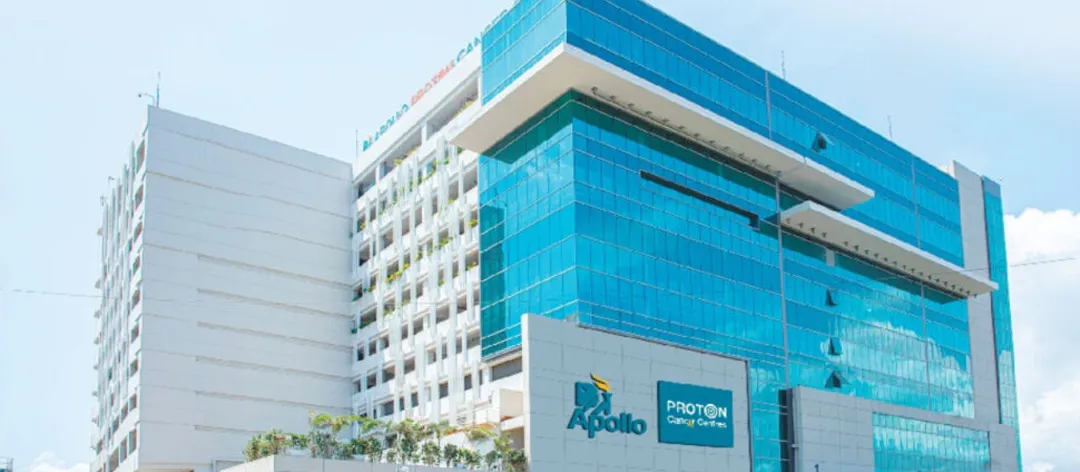
Apollo Proton Cancer Centre opened in Chennai as the first and only proton therapy centre in South Asia and the Middle East. It was also India's first cancer hospital to receive Joint Commission International accreditation — the same international standard applied to the world's top private hospitals. It is part of the Apollo Hospitals Group, India's largest private healthcare network.
APCC operates as a fully integrated, multimodality cancer centre. Surgical oncology, radiation oncology and medical oncology are delivered under one roof, supported by a multidisciplinary Cancer Management Team that reviews all cases before treatment is initiated. The centre serves more than 2,300 outpatient visits daily and handles over 200 international patient consultations every month.
Apollo Proton Cancer Centre — Key Credentials
Source: Apollo Hospitals, IBA Proton Therapy, JCI International. Credentials independently accredited and publicly verified. |
The Technology: IBA Proteus PLUS, Pencil Beam Scanning and IMPT
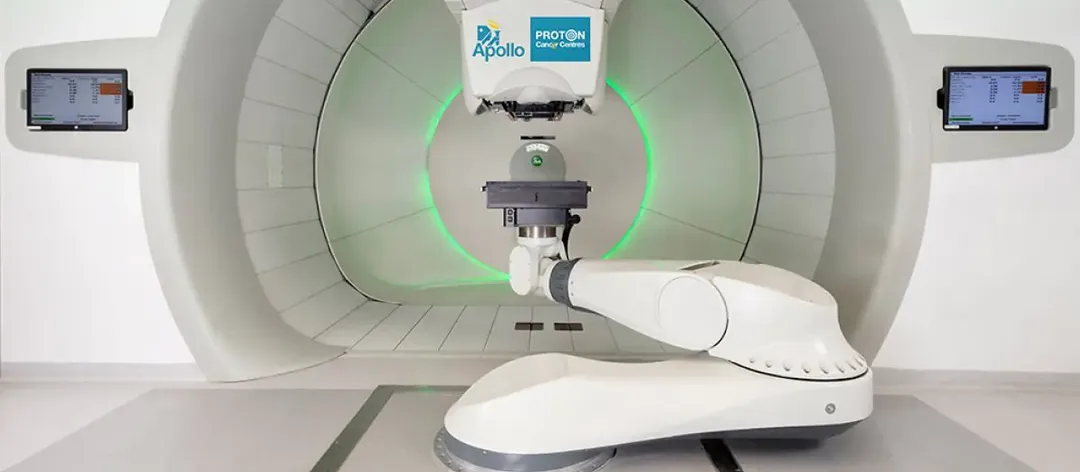
IBA Proteus PLUS System
Apollo Proton Cancer Centre uses the IBA Proteus PLUS system — one of the most advanced proton therapy platforms available globally. The facility houses three dedicated treatment rooms, each equipped with 360-degree rotation gantries that allow the proton beam to be directed at the tumour from any angle. This full rotational capability is essential for precision pelvic treatments, including prostate cancer.
Pencil Beam Scanning
Rather than using a broad, scattered proton beam, APCC delivers treatment exclusively through Pencil Beam Scanning — a highly refined technique in which a narrow proton beam, approximately the diameter of a pencil tip, is moved point by point and layer by layer across the tumour volume. The beam precisely follows the three-dimensional shape of the tumour, depositing radiation exactly where it is needed and nowhere else.
Intensity-Modulated Proton Therapy (IMPT)
IMPT is the most advanced form of Pencil Beam Scanning available, and represents the clinical standard at APCC. In IMPT, the intensity of the proton beam is adjusted at every individual delivery point, allowing three-dimensional dose sculpting around complex tumour shapes and critical adjacent structures. For prostate cancer, this enables the clinical team to maximise dose to the prostate while achieving significant sparing of the rectum, bladder and neurovascular bundles.
Real-Time Tumour Tracking and Image-Guided Delivery
Tumours can shift during a treatment session due to bladder filling, rectal gas or breathing. APCC's system includes real-time tumour tracking and image-guided radiotherapy (IGRT) to monitor patient positioning and tumour location during each session, with automatic adjustment of the beam delivery plan as required. Daily calibration of the proton delivery system and patient-specific treatment plan verification before each first session are standard protocol.
Proton Therapy for Prostate Cancer: Who Is It Right For?

Proton therapy is most appropriate for patients with localised to locally advanced prostate cancer — where the cancer is contained within or closely around the prostate and has not spread to distant organs. The Apollo clinical team evaluates eligibility based on a thorough multidisciplinary assessment including cancer staging, PSA level, Gleason score and prior treatment history.
Strong Candidates for Proton Therapy at APCC
- Men with low, intermediate or high-risk localised prostate cancer who prefer a non-surgical route that preserves surrounding anatomy.
- Patients for whom precise radiation delivery is particularly important — for example, where prior surgery, anatomy or proximity of the rectum or bladder creates a narrow margin for radiotherapy.
- Men who have previously received radiation and require re-irradiation, where the reduced exit dose of proton therapy makes a second treatment course safer.
- Patients who wish to avoid the recovery period associated with radical prostatectomy, or who are not surgical candidates due to other health factors.
- Men who have been informed that proton therapy is their preferred option by an oncologist at home but face prohibitive cost or long waits for the procedure.
Five-Year Outcomes
Apollo Proton Cancer Centre reports a five-year survival rate exceeding 90 per cent for early-stage prostate cancer treated with proton therapy. This is consistent with published outcomes data from leading proton therapy centres globally, where localised prostate cancer treated with modern IMPT demonstrates excellent disease control with a favourable long-term quality of life profile.
Robotic Surgery and the Full Treatment Menu at Apollo Proton Cancer Centre

While proton therapy is APCC's primary distinction for prostate cancer, the centre offers the complete spectrum of treatment modalities. All cases are reviewed by the multidisciplinary Cancer Management Team to determine the most appropriate treatment approach based on the individual patient's clinical profile.
Proton Therapy — IMPT with Pencil Beam Scanning
The primary treatment offering at APCC. Delivered in daily outpatient sessions over 4 to 7 weeks. No hospitalisation required. Treatment sessions typically last 20 to 50 minutes each.
Robotic Prostatectomy — Da Vinci System
APCC operates a Da Vinci robotic surgery suite within 5 modular MRI-integrated operating theatres. Nerve-sparing robotic prostatectomy is available for patients for whom surgical removal is the recommended or preferred approach, with the same precision and continence-preservation goals as leading robotic surgery programmes globally.
TomoTherapy and Advanced IMRT
For patients in whom conventional radiotherapy is appropriate, APCC's TomoTherapy system delivers helical IMRT with daily image guidance, combining treatment delivery and imaging in a single machine. This is available for cases where proton therapy is not clinically indicated or not preferred by the patient.
Medical Oncology: Hormone Therapy and Systemic Treatment
APCC's medical oncology programme delivers hormone therapy (androgen deprivation therapy), chemotherapy and targeted systemic agents for patients with locally advanced or metastatic prostate cancer, or for those in whom systemic treatment is required alongside or following radiation.
Diagnostic Services
- PSMA PET-CT using Gallium-68: the most sensitive molecular imaging available for prostate cancer staging and recurrence detection. Available at APCC at approximately ₹1 to 2 lakh ($1,200 to $2,400) — a fraction of equivalent costs in the United States or Europe.
- MRI-guided fusion biopsy for precise prostate sampling.
- Genomic profiling and digital pathology for precision treatment planning.
- AI-powered diagnostic imaging review as part of the multidisciplinary assessment process.
Cost of Proton Therapy and Prostate Cancer Treatment at Apollo Chennai

India's cost advantage for proton therapy is the most significant of any comparable destination. Proton therapy in the United States costs between $150,000 and $250,000 for a full course. The same treatment at Apollo Proton Cancer Centre in Chennai costs between ₹20 and 30 lakh — approximately $12,000 to $36,000, depending on the treatment protocol, number of sessions and complexity of the case. This represents a saving of 80 to 90 per cent against US pricing.
| Treatment | Cost at Apollo Chennai | Cost in USA / UK | Saving |
| Proton Therapy (full course) | ₹20–30 lakh (~$12,000–$36,000) | $150,000–$250,000 (USA) | 80–90% saving |
| Proton Therapy (full course) | ₹20–30 lakh (~$12,000–$36,000) | £50,000–£80,000 (UK private) | 70–85% saving |
| Robotic Prostatectomy (Da Vinci) | ₹10–20 lakh (~$12,000–$24,000) | $25,000–$45,000 (USA) | 50–70% saving |
| HIFU (focal therapy) | ₹10–15 lakh (~$12,000–$18,000) | $25,000–$40,000 (USA) | 50–65% saving |
| PSMA PET-CT staging scan | ₹1–2 lakh (~$1,200–$2,400) | $4,000–$6,000 (USA) | 60–70% saving |
Cost estimates are based on published and verified pricing data for international patients at Apollo Proton Cancer Centre as of 2025 to 2026. Final costs depend on the specific treatment protocol, number of fractions, diagnostic requirements and whether combination treatments are required. My1Health patient support specialists can arrange a personalised cost estimate based on your diagnosis and medical records.
The Patient Journey: From First Enquiry to Returning Home

Step 1: Remote Pre-Travel Consultation
My1Health arranges a teleconsultation with the Apollo Proton Cancer Centre clinical team before you book flights. Your medical records, imaging and biopsy reports are shared securely and reviewed by the treating oncologists and the multidisciplinary tumour board. You receive a written treatment recommendation, a personalised protocol and a full cost estimate before you commit to travel.
Step 2: Medical Visa and Logistics
Apollo Proton Cancer Centre's international patient team provides a support letter for the Indian medical visa application, which is typically processed within 5 to 7 working days. My1Health coordinates airport transfers and can assist with accommodation near the hospital. Chennai International Airport is 12 kilometres from APCC.
Step 3: Arrival and Treatment Planning
Treatment planning at APCC typically takes 3 to 5 days on arrival. This includes simulation CT and MRI scans in the treatment position, the creation of immobilisation devices, and the construction of the individual IMPT treatment plan by radiation physicists and oncologists. This planning phase is essential to the precision of proton therapy and is not abbreviated.
Step 4: Treatment
Proton therapy for prostate cancer is delivered in daily outpatient sessions, Monday to Friday, over 4 to 7 weeks depending on the prescribed protocol. Most patients remain active and mobile throughout treatment, returning to accommodation between sessions. Treatment sessions themselves last 20 to 50 minutes, including set-up and verification.
Step 5: Discharge and Follow-Up
Before discharge, APCC provides a full clinical summary, post-treatment monitoring schedule and instructions for ongoing management. My1Health coordinates the communication between APCC and your oncologist or GP at home, ensuring continuity of care. Most patients return home within 1 to 2 weeks of completing their treatment course.
Continue Reading
Overview of all advanced prostate cancer treatments:
Prostate Cancer Treatment Abroad: Advanced Options That Protect Your Quality of Life
Compare all four destinations:
Robotic surgery and advanced prostate cancer treatment in Turkey:
Proton therapy and robotic surgery in Singapore: